Significant Findings: Menu
Extinction Shift Principle�
CLICK on a Menu Topic
| Topic 1 |
Solid evidence for direct interaction between gravitation and electromagnetism, as predicted by the light bending rule of General Relativity, does not take place in empty vacuum space. Radio waves in the microwave frequency spectrum resonate with solar plasma atmosphere with frequency and impact parameter dependent propagation time delay. |
|||||
| Topic 2 |
Within current technical means, the light bending effect of the sun should be easily detectable well beyond the thin plasma rim of the sun, in the plasma-free vacuum space for distances of several solar radii. |
|||||
| Topic 3 |
Principle of Reciprocity applied to the Einstein Ring calculation, the general and special cases |
A symmetry requirement for gravitational lensing of General Relativity is demonstrated. Deflection of light rays by point-like gravitating mass and integrated effect thereof is shown to exhibit both an accumulative and equal bending effect upon approach and receding the impact parameter. |
||||
| Topic 4 |
Principle of Reciprocity and Gauss' Law applied to Einstein Ring and Solar Light Bending |
The principle of reciprocity and Gauss' Law of gravity is applied the gravitational lensing as suggested by the light bending rule of General Relativity. Observational evidence from solar rim to the empty vacuum space at high impact parameters are bounced against General Relativity. |
||||
| Topic 5 |
Gauss's Law applied to the Plasma Limbs of the Sun and Stars |
Focal Length of the Plasma Limb of a Sun-like Lensing Star (1 solar mass, 1 solar radius)
The Reason Why Einstein Rings Are Not Observed in the Night Skies (Now Explained) |
||||
| Topic 6 |
Shapiro Delay, a frequency dependent transit time effect, not a Space Time effect |
The Shapiro delay is found to be only a good fit to the transit time data of microwave signals as a function of the frequency of the transmitted link and the impact parameter of the microwave ray relative to the sun. Transit time delays are found to be a property of solar winds acting on the propagation of all waves at microwaves frequencies resonating with the plasma and solar winds. |
||||
| Topic 7 | Principle of Reciprocity Demonstrated on the Einstein Ring as function of light source distance |
The principle of reciprocity is demonstrated on the predicted observation of the Einstein ring as function of the distance from the light source. |
||||
| Topic 8A | Most Significant Findings |
|
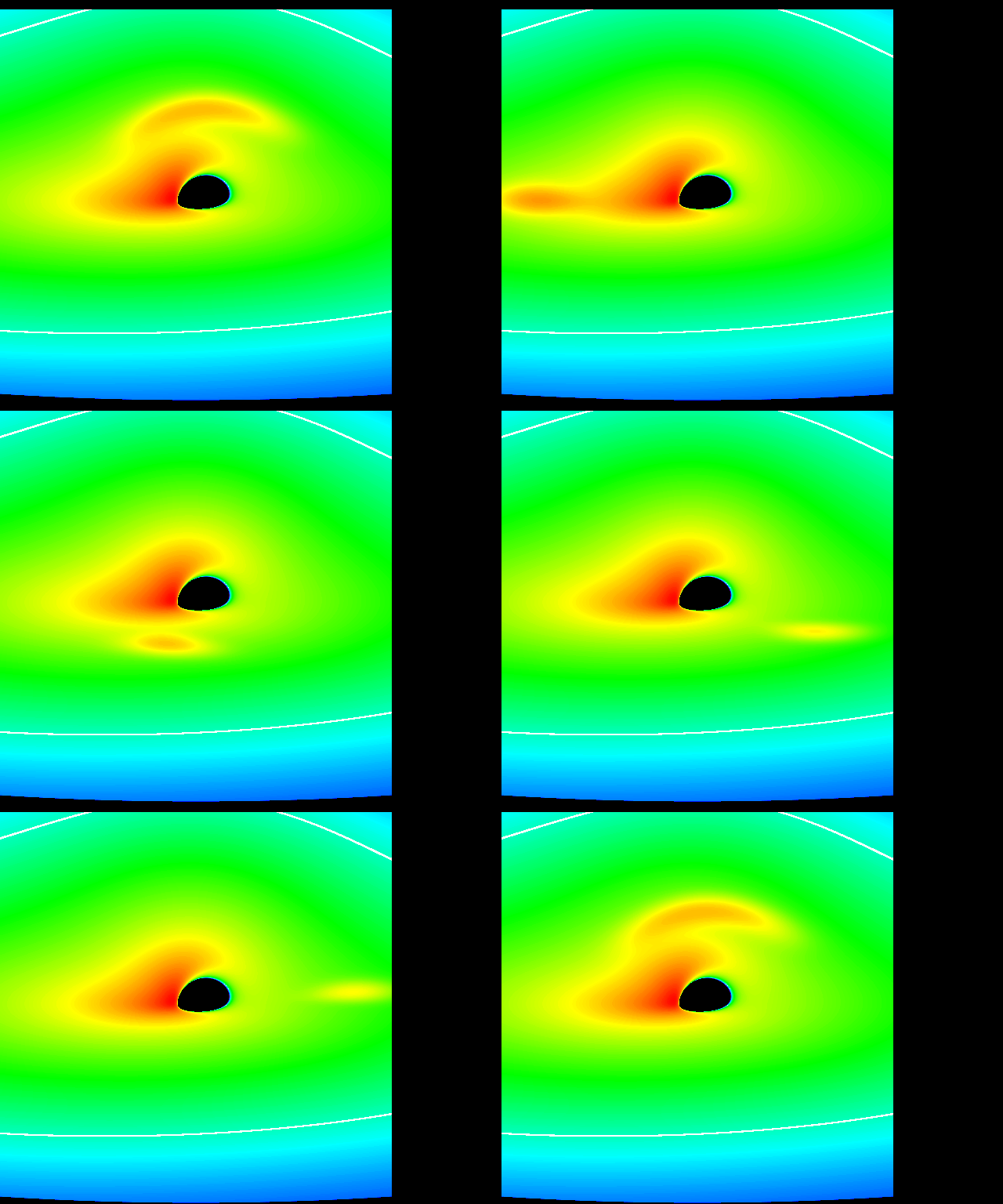
There is no evidence for a time resolved gravitational lensing event as predicted by General Relativity and depicted in the artist animation here. The academic textbooks and the literature are filled with artist impressions pertaining to gravitational lensing effects similar to the one depicted here. |
|||
| Topic 8B |
New Findings
on Gravitational Lensing Galaxies
FALSE ALARMS? |
|
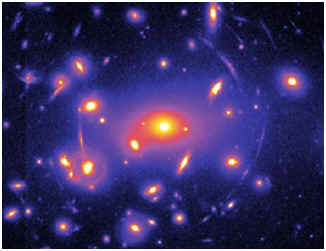
Electromagnetic radiation is commonly scattered by interstellar and intergalactic grains of dust. Recognizable features of curved arcs encircling the intense light of dense galactic cores are repeated in virtually all galaxy clusters allegedly claimed to be gravitational lenses. A clear fact: no region in interstellar and intergalactic space is free of light scattering. |
|||
| Topic 8C | Significant Findings on Atomic Clocks |
|
New Significant Findings: Clock Second of an Atomic Clock as function of the Gravitational Potential Gradient of the Earth. Click: Clock Second as function of Gravitation Potential Gradient
|
|||
| Topic 9 | Publications | Publications and References | ||||
| Topic 10 | Upcoming Lectures | |||||